Everlucent Vault™ presents
Navigating Menopause TogetherCE Course
You learned the physiology. Now learn how to manage the visit.
A practical, evidence-based menopause and hormone therapy course for nurse practitioners and advanced practice clinicians who want a clearer framework for evaluating patients, selecting treatment, prescribing, troubleshooting, and managing follow-up in everyday practice.
Enroll now
$99
$199 regular
Plus applicable tax · One-time payment · 12-month access · All sales final
5.5
AANP-approved contact hours
3.66
Pharmacology hours
260800057
Activity ID#
Self-paced · Online · Certificate on completion
$99
Regular $199
$99 plus applicable tax
Introductory pricing ends October 31, 2026. Enrollment increases to $199 on November 1, 2026.
The gap
Knowing the evidence is different from knowing what to do next.
Many clinicians understand menopause physiology but were never given a practical framework for managing the actual visit. You may know hormone therapy can be appropriate — but still find yourself asking:
- Is she a candidate for systemic MHT?
- Oral or transdermal?
- What starting dose?
- What does she need for endometrial protection?
- Does she actually need hormone testing?
- What changes if she is still cycling?
- What if she has migraine with aura, VTE risk, or a breast cancer history?
- What if she starts bleeding?
- What if HRT is not working?
- How should testosterone be approached for HSDD?
- How do I turn all of this into a prescription, follow-up plan, and defensible chart note?
Navigating Menopause Together CE Course was built for that gap. The goal is not simply to know more about menopause. It is to know what to do next.
What makes this different
The course teaches the reasoning. The toolkit helps you use it.
Most CE ends when you pass the post-test. This was built to keep working after it. Enrollment includes a separate interactive Menopause Clinical Toolkit and Provider Reference built around the clinical questions that arise after the lecture ends.
Risk → candidacy → treatment selection → dosing → prescribing → troubleshooting → documentation → patient education
One route swap + smoking status
What does switching the patch to a pill actually cost her?
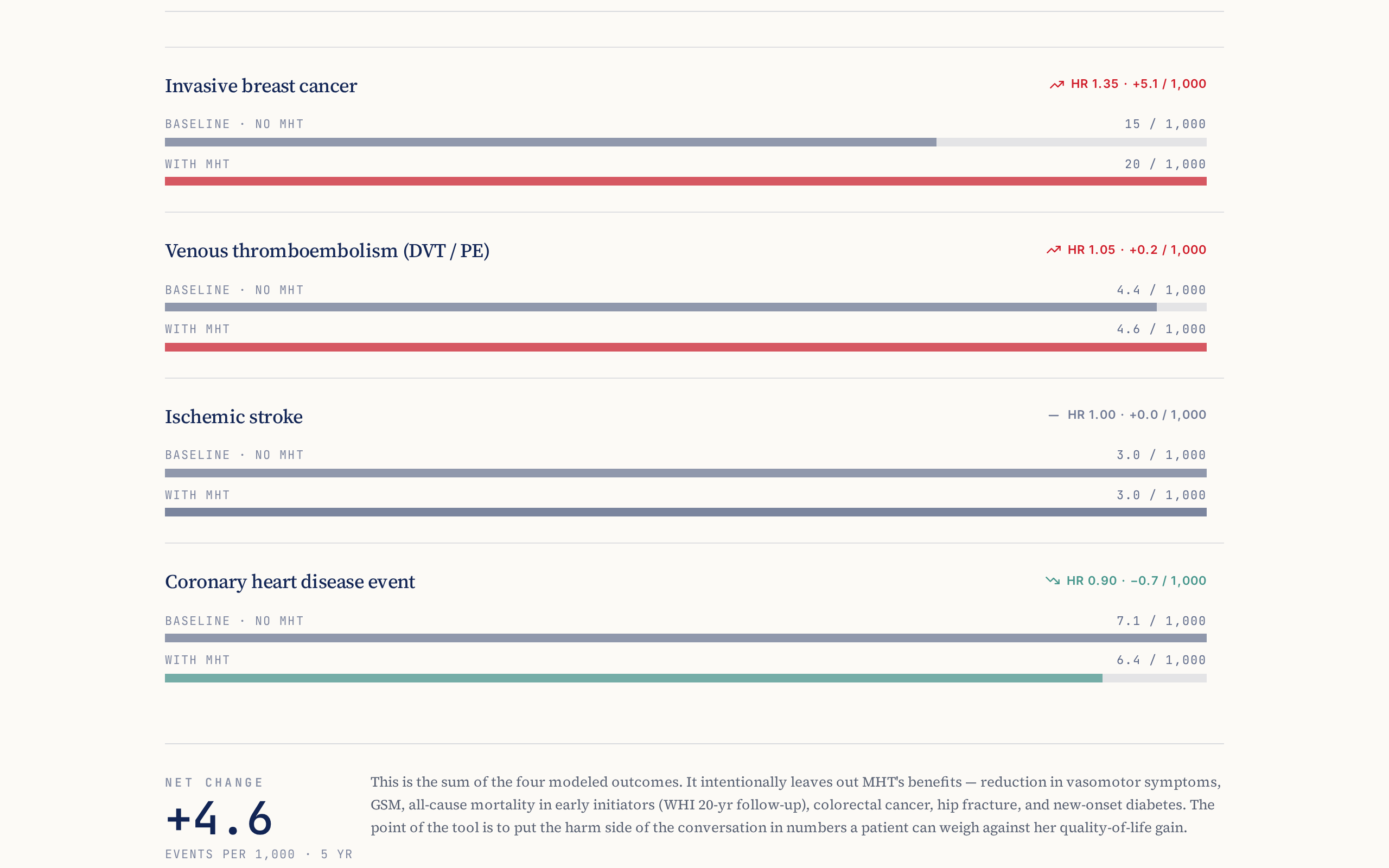
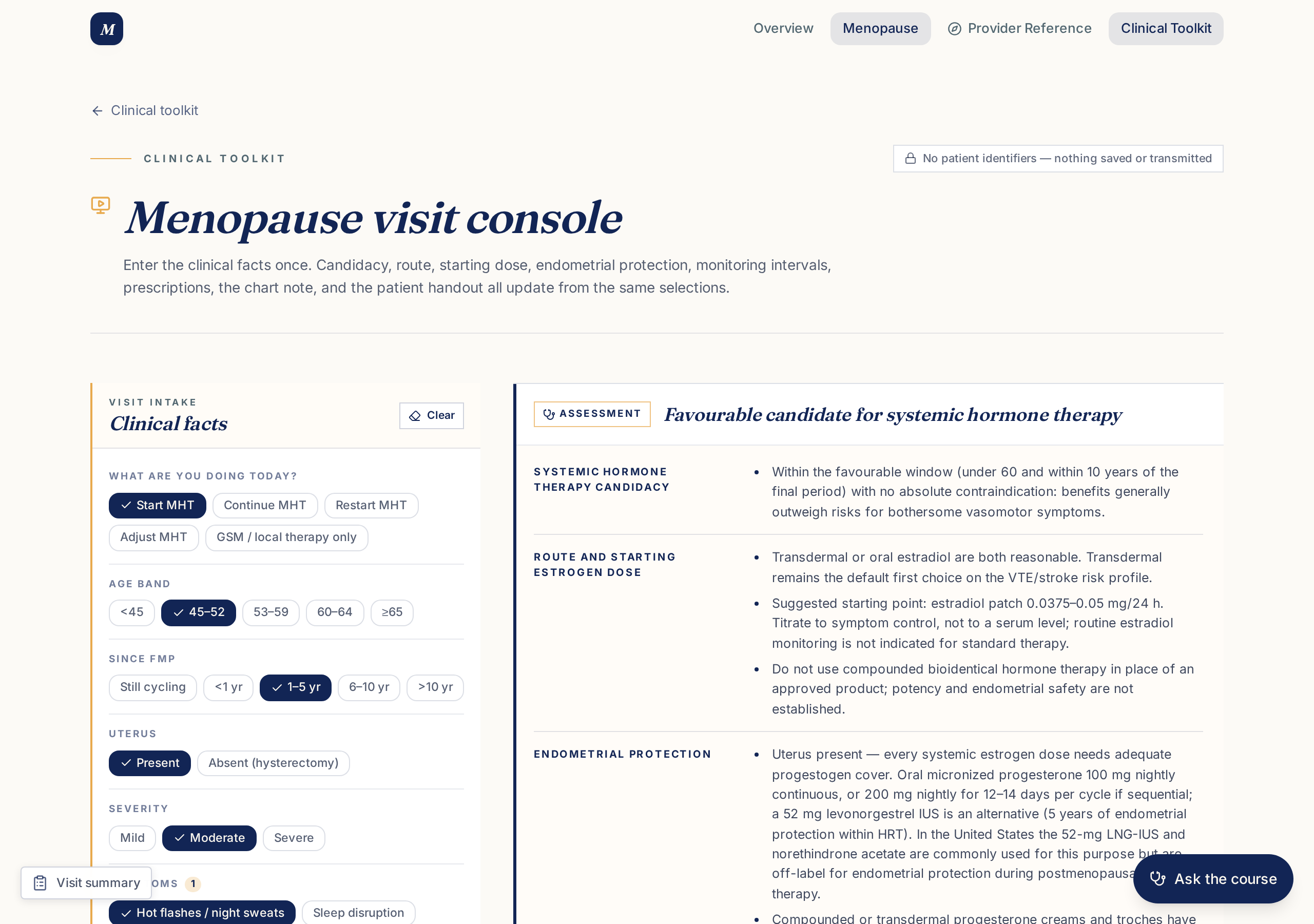
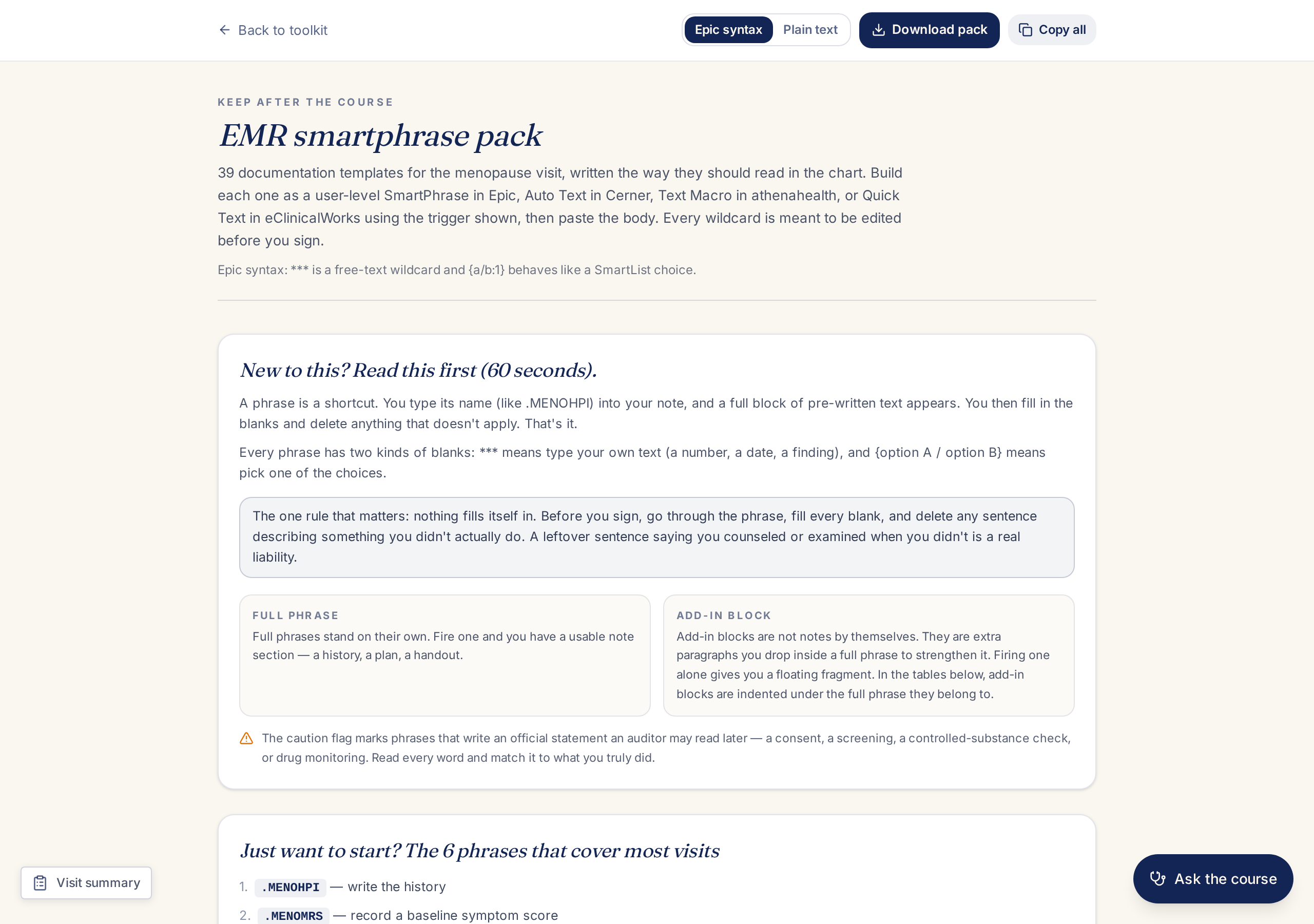
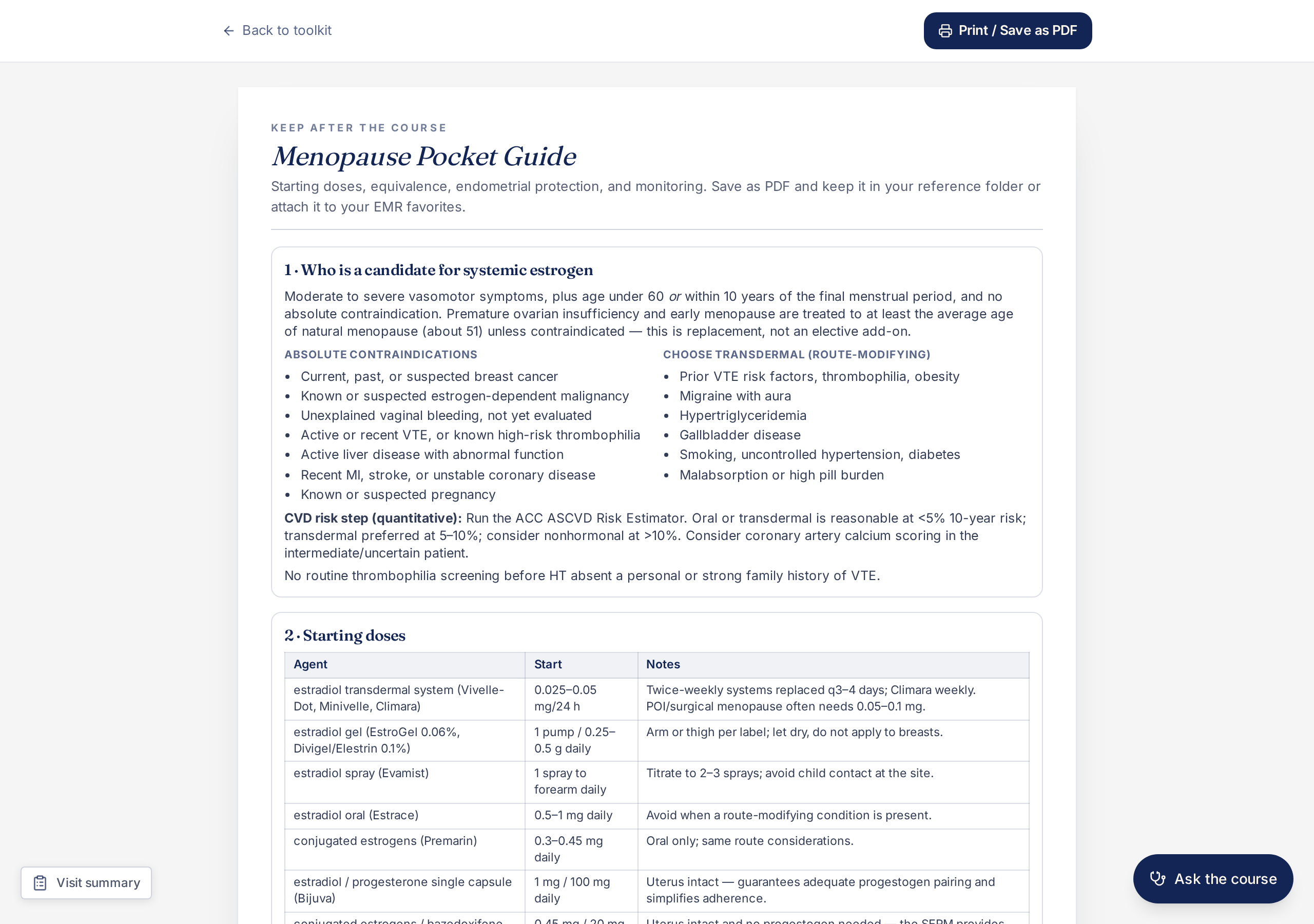
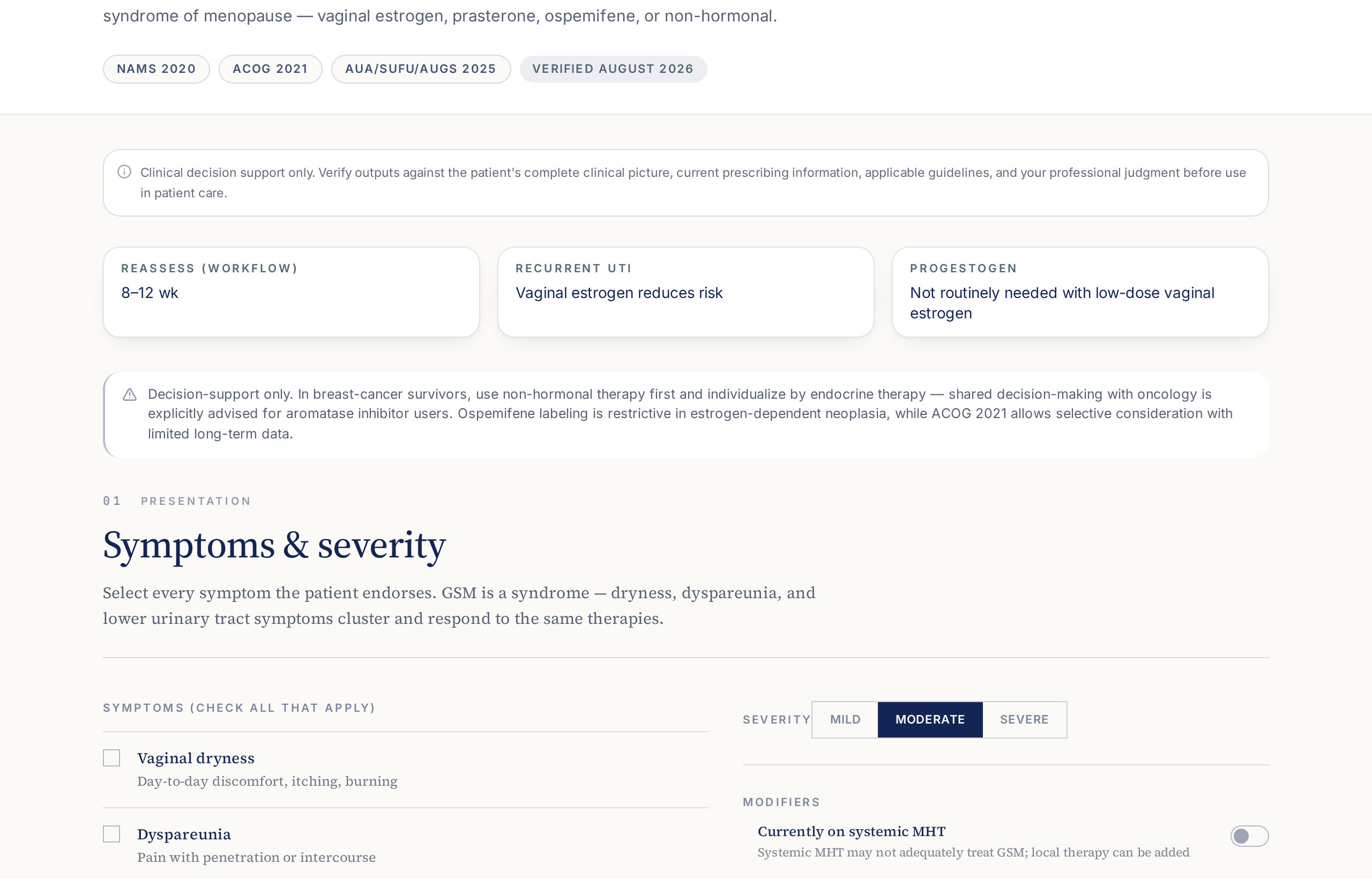
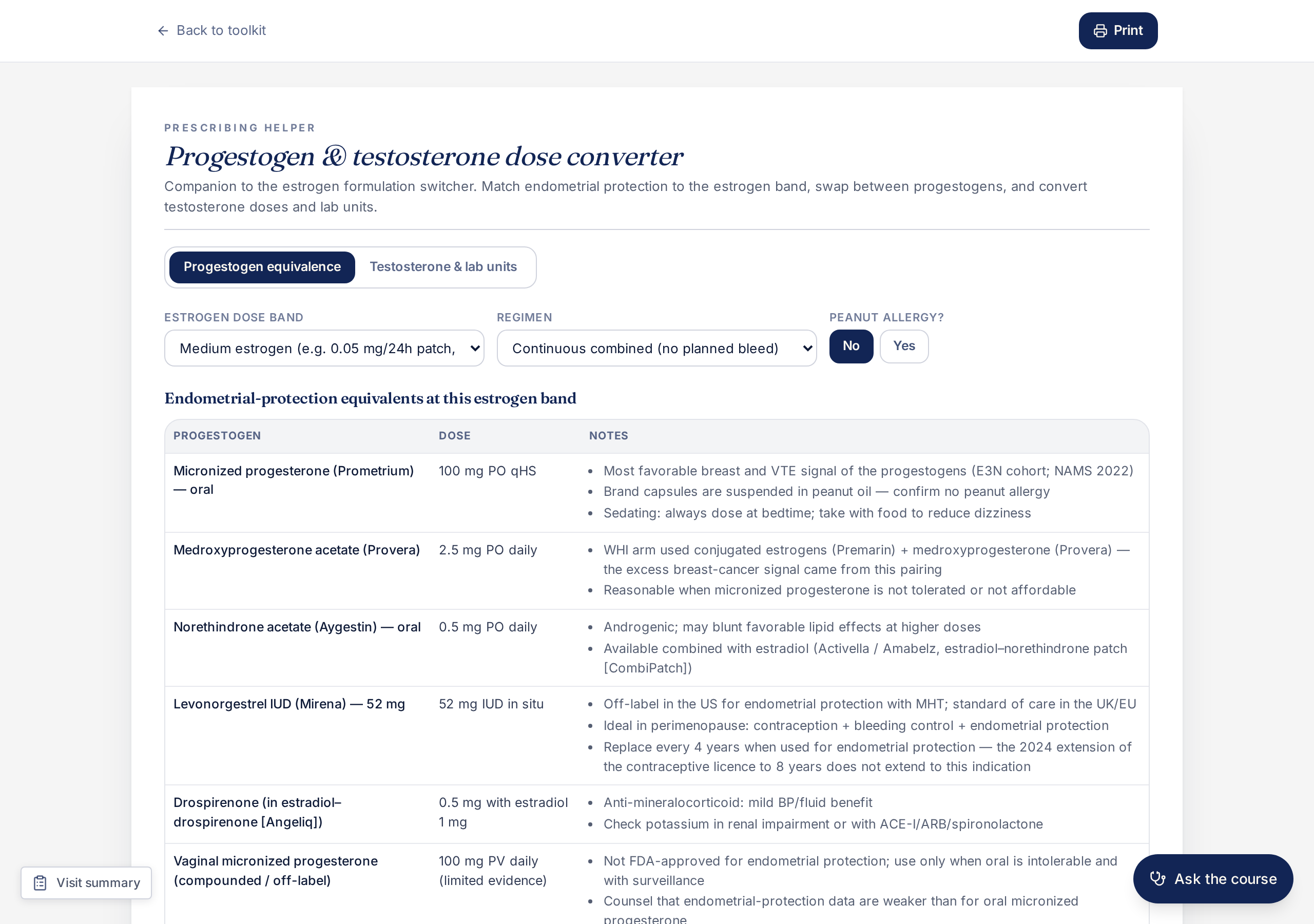
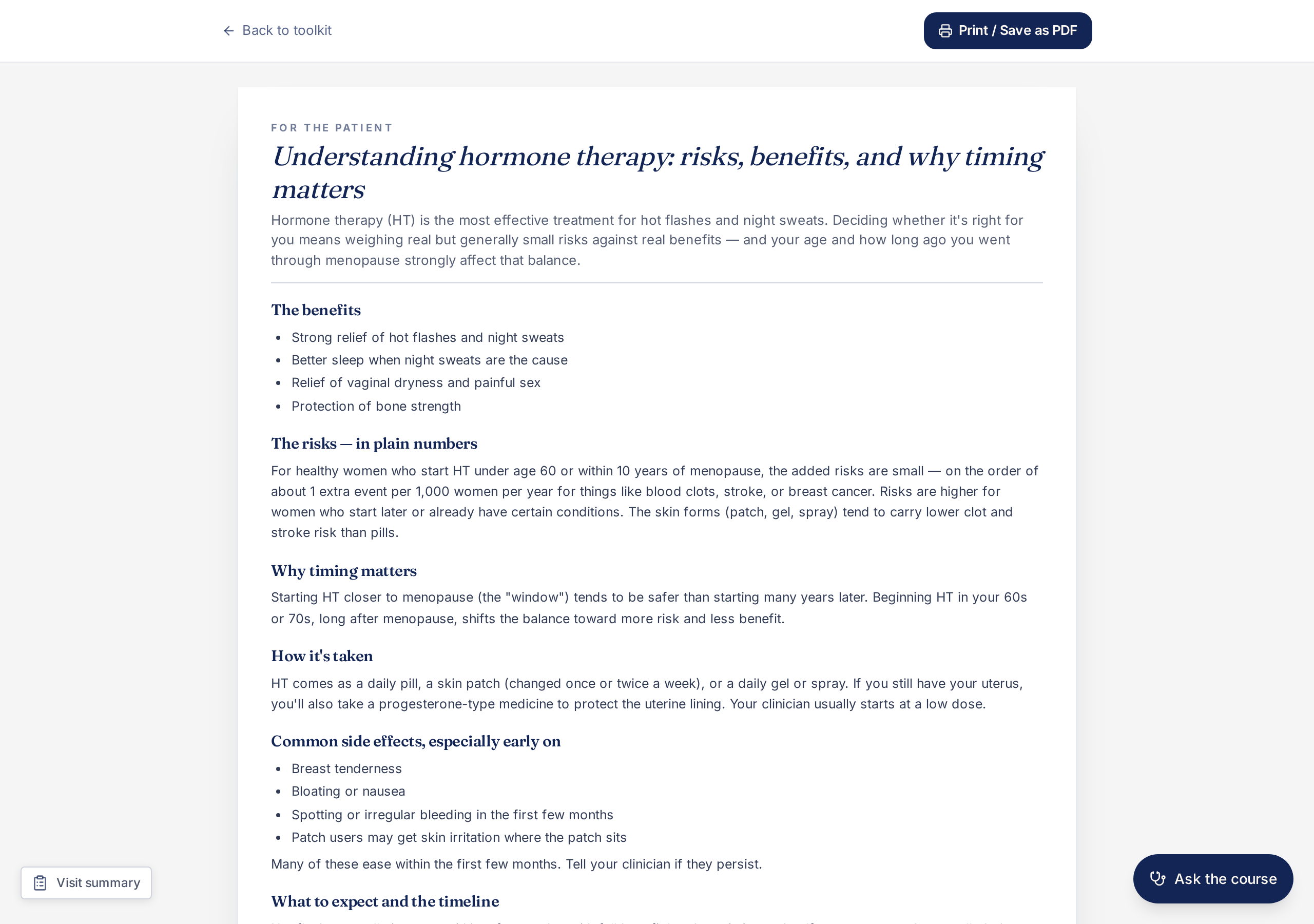
Actual screens from the Menopause Clinical Toolkit. Every output is generated from what you enter — including the chart note you can copy into the EMR.
Menopause Visit Console
One clinical intake. One connected workflow.
Enter the patient's
- Age and reproductive stage
- Time since final menstrual period
- Uterine status
- Symptom burden
- Contraindications
- Relevant risk modifiers
- Medical history
Enter the clinical facts once. The same selections carry forward through the encounter.
Candidacy
Is systemic hormone therapy reasonable to consider?
Route & dose
Oral or transdermal? What is an appropriate starting point?
Endometrial protection
What does she need if a uterus is present?
Prescribing
Formulation, strength, application schedule, quantity, refills, and product-specific counseling.
Monitoring
Know what to reassess and when.
Documentation
A detailed HPI, focused safety review, problem-oriented A&P, counseling language, and after-visit instructions — built only from what you actually entered.
Patient education
Finish the visit with plain-language resources.
HRT Decision Tree
When the patient does not fit the textbook, follow the branch.
Move from the presenting concern to a treatment pathway one decision at a time.
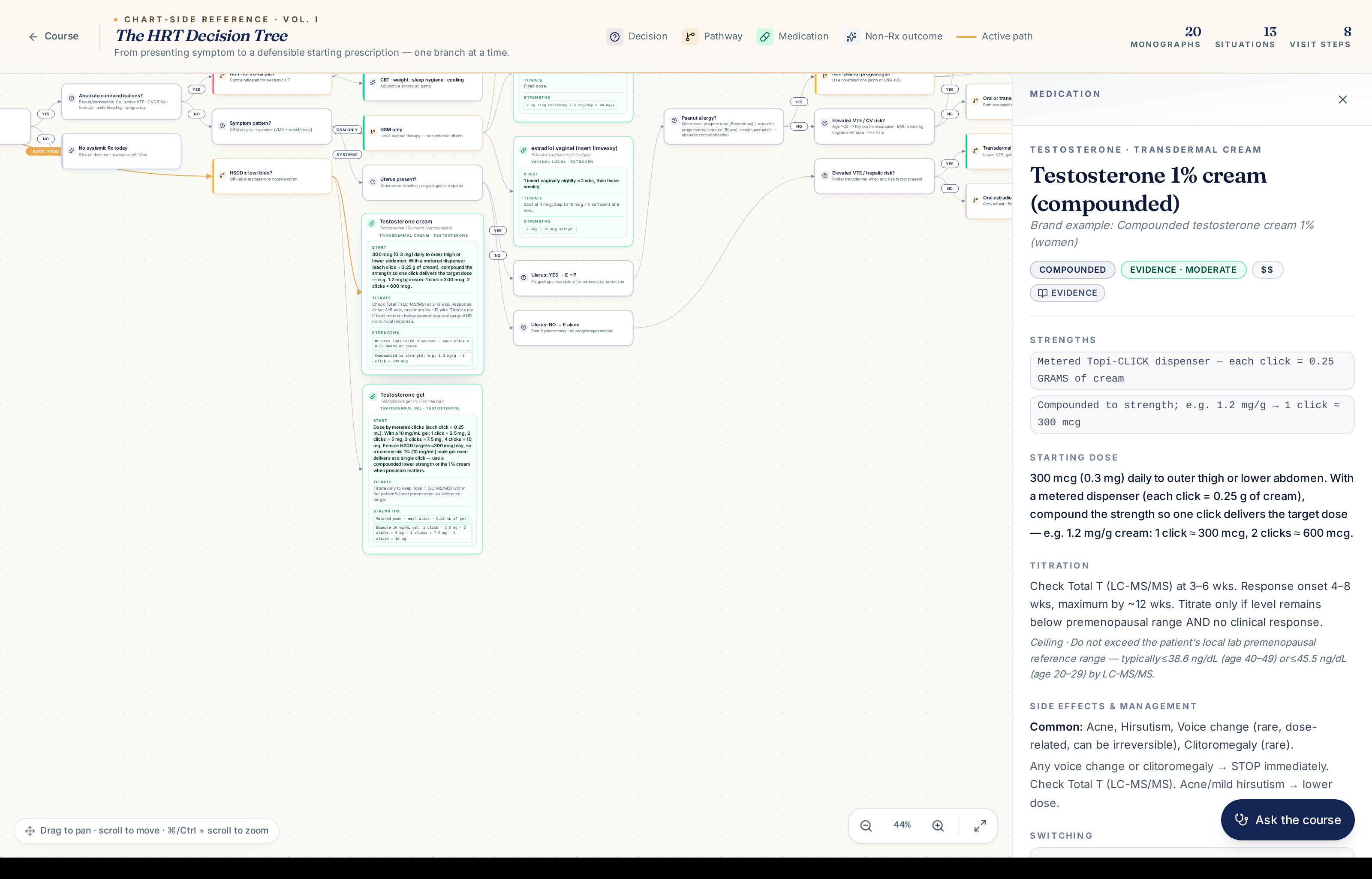
The Menopause Clinical Toolkit and point-of-care resources are supplemental resources and are not part of the AANP-approved continuing education activity.
Support after the lecture ends
Ask the course. Get sourced answers.
Stuck on a complex case after you have finished a module? The Clinical Assistant lets you ask evidence-grounded questions inside the course and returns answers tied to the toolkit, references, and current literature.
Ask the course — built for the questions that come up in practice
Ask about contraindications, route selection, dosing, bleeding, GSM, testosterone, nonhormonal options, or how to apply a guideline to a specific patient. The assistant searches peer-reviewed literature and maps the response back to the same decision tools and prescribing framework used in the course.
Evidence-grounded
Answers cite guidelines, literature, or toolkit references.
Tool-aware
Responses point to the relevant calculator, decision tree, or SmartPhrase.
Included with enrollment
No extra subscription — access it whenever you are inside the course.
Learning aid
Designed to support clinical reasoning, not replace professional judgment.
The Clinical Assistant is a supplemental learning resource and is not part of the AANP-approved continuing education activity.
What is included
Everything in the package.
24
Interactive clinical tools
40
EMR SmartPhrases
8
Printable patient handouts
15
Real-world scenarios
AANP-approved continuing education
5.5 contact hours · 3.66 pharmacology hours
24 interactive clinical tools
Point-of-care
Risk calculators, candidacy checkers, regimen builders, dose converters, bleeding triage, titration troubleshooting, testosterone/HSDD tools, GSM planning, and more.
40 EMR SmartPhrases
Copyable dot phrases
Reusable documentation language for initial visits, HRT follow-up, GSM, unscheduled bleeding, risk counseling, after-visit instructions, and more.
8 printable patient handouts
Plain-language education
Plain-language education on treatment options, route choice, nonhormonal hot flash therapy, vaginal dryness, vaginal estrogen after breast cancer, bone/heart health, and more.
14 real-world case scenarios
11 clinical cases + 3 conversation cases
See how decisions change based on age, reproductive stage, uterine status, symptoms, contraindications, medications, risk factors, and treatment response.
Point-of-care reference library
Provider Reference
Provider Reference, Menopause Pocket Guide, Prescription SIG Library, laboratory testing guide, SHBG/testosterone interpretation, perimenopause/contraception, POI/surgical menopause, adverse-effect guide, duration/tapering/stopping, compounded hormone counseling, and more.
Primary resource
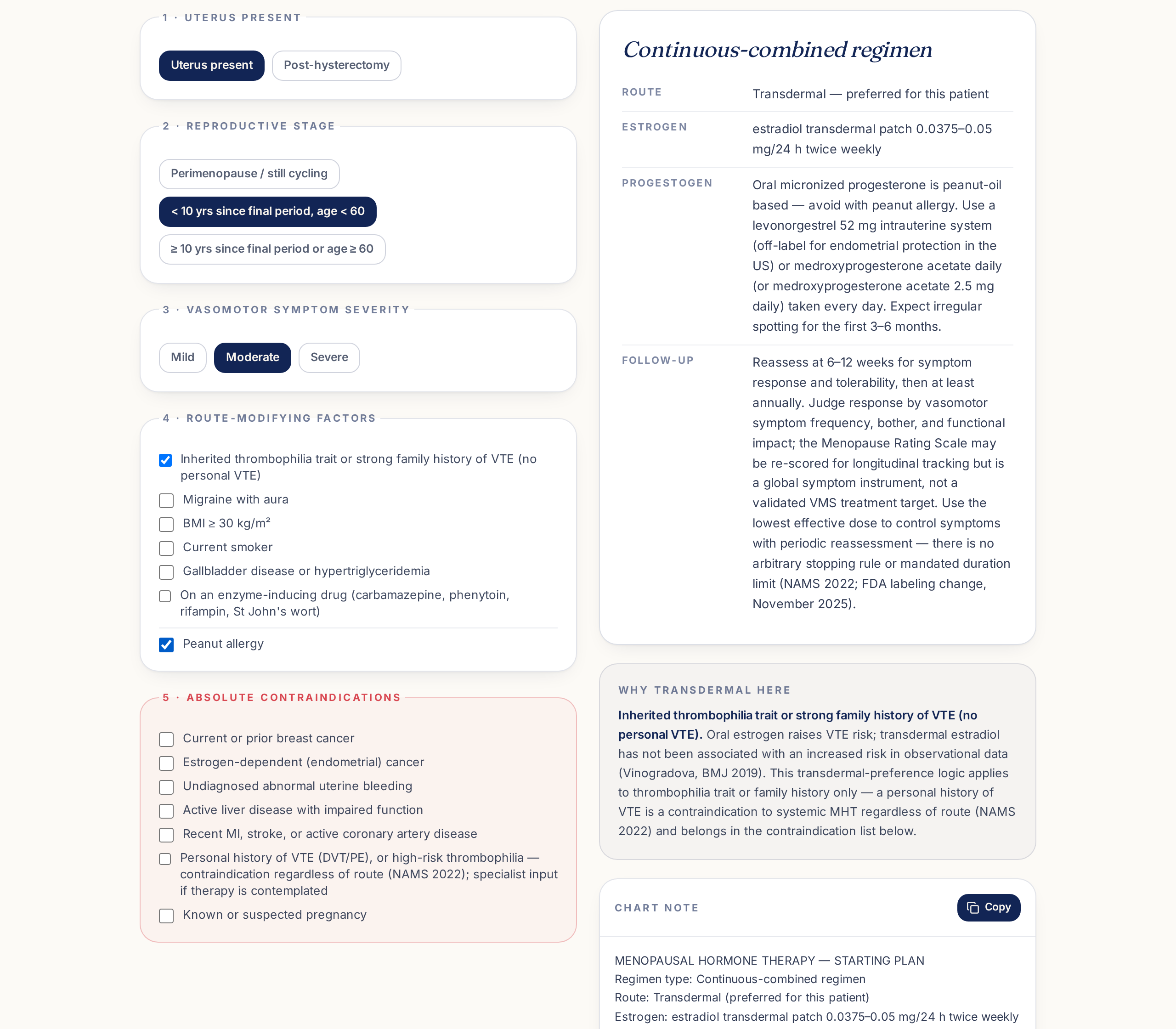
Starting regimen builder
A complete starting plan, not a list of options.
The tools support the visit.The course builds the clinical reasoning behind them.
Why I created it
The menopause course I wish I had when I started practicing.
When I began practicing as a family nurse practitioner in primary care in 2015, I referred nearly every menopause-related concern to gynecology. Not because I believed menopause care belonged somewhere else. Because I had never been taught how to manage it.
As I learned more and began caring for more patients during the menopause transition, I kept coming back to the same question: why were so many women struggling through menopause without receiving thoughtful evaluation and evidence-based care?
That question changed the direction of my work. Navigating Menopause Together CE Course is the resource I wish I had early in my career — a practical, evidence-based course designed to translate current guidelines and primary literature into everyday clinical decision-making.
— Mallory Jones, MSN, APRN, FNP-C, CWHS
Course curriculum
10 parts, built in visit order.
The course follows the encounter itself — recognition, evaluation, treatment selection, follow-up, and the complex cases that do not fit the algorithm.
Part I — Foundations
Menopause physiology, STRAW+10, WHI, and the evidence that shaped modern hormone therapy.
Part II — Recognizing Menopause
Vasomotor, genitourinary, sleep, mood, cognitive, musculoskeletal, and less-recognized presentations.
Part III — The Menopause Visit
History, exam, lab testing, risk stratification, and shared decision-making.
Part IV — Hormonal Treatment
Estrogen routes and doses, endometrial protection, testosterone, GSM, route conversion, and compounded therapy.
Part V — Non-Hormonal Treatment
NK-receptor antagonists, SSRIs/SNRIs, gabapentin, oxybutynin, CBT, and supplement evidence.
Part VI — Follow-Up & Titration
Dose adjustment, adverse effects, bleeding, duration, tapering, and stopping.
Part VII — Complex & Adjacent Cases
POI, surgical menopause, contraception transition, breast cancer, VTE, migraine, PCOS, endometriosis, and more.
Part VIII — Midlife Health Beyond Symptoms
Bone health, GLP-1 considerations, and cognitive complaints.
Part IX — Staying Current
Guidelines, new therapies, active studies, and literature updates.
Part X — Quick-Reference Hub
Point-of-care medication references, tools, cases, and evidence.
AANP-approved continuing education
5.5 contact hours · 3.66 pharmacology hours
Activity ID# 260800057 · Enduring material · Self-study · Approved August 12, 2026, valid through August 31, 2027 · Sponsor / Provider: Everlucent Vault LLC · Certificate issued upon successful completion of the required activity components.
This activity is approved for 5.5 contact hour(s) of continuing education (which includes 3.66 hour(s) of pharmacology) by the American Association of Nurse Practitioners®. Activity ID# 260800057. This activity was planned in accordance with AANP Accreditation Standards and Policies.
Who this course is for
Designed for clinicians who care for women during the menopause transition.
- Family nurse practitioners
- Women's health nurse practitioners
- Adult-gerontology nurse practitioners
- Primary care clinicians
- Telehealth clinicians
- Advanced practice clinicians expanding menopause services
- Providers who have already completed menopause education but still want a more practical prescribing framework
You do not need to run a dedicated menopause clinic to use these skills. Menopause walks into primary care every day.
Enroll
Earn the CE. Keep the tools. Use them with your next patient.
Enrollment includes the full self-paced course, the certificate, and 12-month access to the course and all included point-of-care resources.
$99
Regular price $199
$99 plus applicable tax. Sales tax or VAT is calculated at checkout based on your location.
Introductory pricing ends October 31, 2026. Regular price $199 beginning November 1, 2026.
5.5 CE hours · 3.66 pharmacology · 24 tools · 40 SmartPhrases · 8 handouts · 15 scenarios · Clinical Assistant
Enrollment includes
- Full self-paced course
- 5.5 AANP-approved contact hours
- 3.66 pharmacology hours
- Completion certificate
- 24 interactive clinical tools
- 40 EMR SmartPhrases
- 8 printable patient handouts
- 15 case scenarios
- Provider Reference
- Menopause Visit Console
- HRT Decision Tree
- Menopause Pocket Guide
- Clinical Assistant with literature search
- Point-of-care prescribing resources
Learn the evidence. Apply it at the point of care. Know what to do next.
FAQ
Frequently asked questions
- Is this course AANP approved?
- Yes. Navigating Menopause Together CE Course is approved for 5.5 contact hours of continuing education, including 3.66 pharmacology hours, by the American Association of Nurse Practitioners®. Activity ID# 260800057.
- Is the course self-paced?
- Yes. It is an enduring self-study activity completed online.
- How many pharmacology hours are included?
- 3.66 pharmacology hours are included within the total 5.5 contact hours.
- Is this only an HRT course?
- No. The course covers menopause recognition and evaluation, MHT, nonhormonal treatment, GSM, HSDD/testosterone, bleeding, follow-up, complex cases, bone health, and midlife clinical considerations.
- Do I receive a certificate?
- Yes. A certificate is issued after you complete the required course content, pass the final examination, and submit the evaluation.
- What is your refund policy?
- All sales are final. Enrollment grants immediate access to the full course content and toolkit, so purchases are non-refundable. Duplicate or erroneous charges are always refunded in full.
- Are the interactive tools part of the AANP-approved CE activity?
- They are included with enrollment, but they are supplemental. The Clinical Toolkit, Visit Console, HRT Decision Tree, Provider Reference, and calculators are point-of-care resources that sit alongside — and are separate from — the AANP-approved continuing education activity.
- How long do I keep access to the toolkit and references?
- Enrollment includes 12-month access from enrollment to the course, the Clinical Toolkit, and all point-of-care references.
- Does the price include tax?
- Enrollment is $99 plus applicable tax. Sales tax or VAT is calculated at checkout based on your location and is collected and remitted by the payment processor.
What's next from EverLucent Vault
EverLucent Vault launches this August.
A new platform for healthcare professionals and organizations is currently in private development. Join the early access list for launch updates, first invitations, and founding pricing.
Platform
EverLucent Vault launches this August
A new platform for healthcare professionals and organizations is currently in private development.
EverLucent Vault is launching in August to help providers and healthcare organizations keep complex professional and administrative work more connected, visible, and easier to manage.
Join the early access list for launch updates, first invitations, and founding pricing.
Continuing education
More continuing education is coming
Navigating Menopause Together is the first AANP-approved continuing education activity available through EverLucent.
Additional courses are in development.
Get CE updates and subscriber pricing on your next course.